Is Your Team Really Ready for AI? Here's How to Know for Sure

Updated: Mar 22
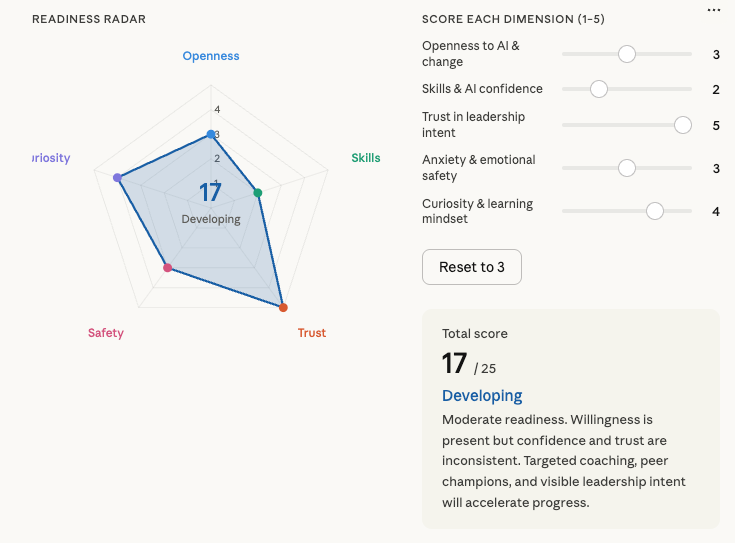
Most AI rollouts don't fail because of the technology. They fail because the people weren't ready.
You've probably seen it: a leadership team invests in a new AI tool, runs a launch session, and then… nothing changes. The tool sits unused, the team quietly reverts to old habits, and the initiative quietly dies.
The problem is rarely the tool. It's the gap between where the team is emotionally, culturally, and practically and where they need to be to adopt something new.
That gap is what the AI Readiness Diagnostic is designed to measure. And we've built a free, interactive version you can use right now.
What is the AI Readiness Diagnostic?
The AI Readiness Diagnostic is a structured scoring tool that helps leaders, managers, and change practitioners assess how prepared a team is to adopt AI — not just technically, but humanly.
It evaluates five dimensions that, together, determine whether an AI initiative will land or stall:
Dimension | What it measures |
Openness | Is the team open to AI and change, or resistant? |
Skills | Does the team have the confidence and capability to actually use AI tools? |
Trust | Does the team trust that leadership's intent with AI is genuinely beneficial? |
Safety | Is anxiety about job security and relevance manageable, or is it blocking progress? |
Curiosity | Is there an intrinsic motivation to learn and experiment, or does the team need to be pushed? |
Why does this matter?
Most organisations approach AI adoption as a technology problem. They invest in tools, licences, training and measure success by activation rates. But the research on change management consistently shows that human factors, not technical ones, determine whether new tools actually change behaviour.
Here's what that looks like in practice:
A team scoring high on Skills but low on Trust will use AI only when nobody is watching and revert the moment they think it's being used to surveil them.
A team scoring high on Openness but low on Anxiety may seem enthusiastic in workshops, but freeze when it comes to applying AI to their real work.
A team scoring high across all five dimensions doesn't just adopt AI, they become internal champions who pull the rest of the organisation forward.
The shape of the pentagon radar matters as much as the total score. A lopsided shape tells you exactly where to intervene first.
How to interpret your score
Each dimension is scored 1–5. Your total score out of 25 places your team in one of five readiness tiers:
Score | Tier | What to do next |
5-9 | Critical | Significant resistance, anxiety, or distrust. Prioritise psychological safety and honest communication before any tool is introduced. |
10-14 | Early stage | Low readiness but not hostile. Needs structured support, visible leadership intent, and small, safe experiments to build confidence. |
15-19 | Developing | Moderate readiness. Willingness exists but is uneven. Focus on peer champions and closing the most critical dimension gap shown in the radar. |
20-22 | Ready | Strong foundation. Shift from preparation to embedding: build habits, celebrate experiments, and expand use cases systematically. |
23-25 | Leading | Exceptional readiness. Engage this team as co-designers of your AI strategy. Their influence on others is your highest-leverage asset. |
How to use the diagnostic
For individual leaders or managers
Use it as a reflection tool before launching an AI initiative. Score your team based on observable behaviours you've already seen, not what you hope is true. The exercise alone will surface blind spots.
For HR, L&D, and change teams
Run it across multiple teams to identify where readiness is highest and where to prioritise support. Teams scoring 20+ are natural early adopter cohorts. Teams scoring below 12 need a different kind of support, often a listening session, not a training course.
For team debrief sessions
Share the radar on screen during a team meeting and score each dimension together. The conversation it generates, about what's blocking curiosity, or why trust feels low, is often more valuable than the score itself.
Track it over time
Re-score every 6–8 weeks during an AI adoption programme. Movement in the radar shape shows you what's working and what isn't, before you invest further.
Try the diagnostic now
The interactive radar is embedded below. Move the sliders, watch the shape change, and read the interpretation for each tier. It takes under 1 minute.
No login required. No data is collected. This tool is completely free to use.
What to do after scoring
The diagnostic is a starting point, not an endpoint. Once you have a score and a shape, the next step is to design an intervention that addresses the specific dimension holding your team back. That might mean:
A series of small AI experiments with psychological safety baked in (for low Openness or high Anxiety scores)
A peer-learning programme where internal AI users share use cases (for low Skills or low Curiosity scores)
A direct conversation between leadership and the team about how AI will and won't be used (for low Trust scores)
A structured AI ambassador programme for teams already scoring in the Ready or Leading tier
Your team’s AI Readiness score is just the starting point. The real question is what should you do with it?
Discover your next move with The AI Adoption Navigator: a six-step interactive tool that interprets your results, detects the hidden patterns behind your team’s readiness gaps, and builds a leadership action plan you can use immediately.
→ Explore the AI Adoption Navigator [Coming Soon]
COMING Q2 2026 · EARLY BIRD NOW OPEN
The Human Advantage: AI + EI
The flagship programme from The Gain Lab
The diagnostic you just used is one piece of a much bigger picture. The Human Advantage is our flagship programme for leaders and teams who want to do more than survive the AI shift; they want to lead it, with the emotional intelligence to bring people with them.
What you'll learn:
How to use the AI Readiness Diagnostic to design targeted, human-centred adoption strategies
The neuroscience of why people resist change and how EI breaks through it
Practical AI tools that amplify emotional intelligence rather than replace it
How to build psychological safety so your team experiments without fear
Leadership habits that turn AI sceptics into advocates
Early bird spots are limited. Be the first to know when enrolment opens, plus get exclusive early bird pricing.
No commitment. We'll only email you about The Human Advantage.
What is an AI readiness diagnostic?
An AI readiness diagnostic is a structured assessment tool that measures how prepared a team or organisation is to adopt artificial intelligence. Unlike technical readiness audits, it focuses on human factors: openness to change, skill confidence, trust in leadership intent, emotional safety, and learning mindset. Each dimension is scored 1–5 to produce an overall readiness tier from Critical (5–9) to Leading (23–25). The result helps leaders understand where to intervene before, not after, rolling out AI tools.
Why do AI adoption programmes fail?
Most AI adoption programmes fail not because of the technology, but because of unaddressed human barriers. These include fear of job loss, low confidence in using tools, distrust of leadership motives, and lack of psychological safety to experiment and fail. Research in organisational change consistently shows that emotional and cultural factors, not technical ones, determine whether new behaviours are sustained. A readiness diagnostic helps surface these barriers before they derail an investment.
How to measure team AI readiness?
Team AI readiness is measured by observing behaviours across five dimensions: openness to AI and change, skills and AI confidence, trust in leadership intent, anxiety and emotional safety, and curiosity and learning mindset. Each dimension is scored 1–5 based on observable team behaviours, from open resistance (score 1) to proactive self-directed adoption (score 5). The five scores combine into a total out of 25, which maps to a readiness tier and recommended intervention strategy.
What is a good AI readiness score?
A score of 20–22 out of 25 indicates a team is Ready for AI adoption: they have strong foundations across most dimensions and can absorb AI tools meaningfully. A score of 23–25 indicates a Leading team that can co-design the AI strategy and influence peers. Scores below 15 suggest foundational work is needed before any tool rollout. The shape of the radar matters too: an uneven profile (high skills, low trust) requires targeted intervention, not a general training programme.


![Generative AI for SMEs in 2026: Practical Strategies, ROI and Singapore Case Examples [Updated]](https://static.wixstatic.com/media/11062b_6cfe88bddafd4b25b6a1fdb650c812c1~mv2.jpg/v1/fill/w_980,h_653,al_c,q_85,usm_0.66_1.00_0.01,enc_avif,quality_auto/11062b_6cfe88bddafd4b25b6a1fdb650c812c1~mv2.jpg)
Comments