You've Diagnosed Your Team. Now What? Introducing the AI Adoption Navigator


This is Part 2 of the AI Readiness series. Part 1: the AI Readiness Diagnostic Tool told you your organisation score. This tool tells you what to do about it.
A score is just a number until someone turns it into momentum.
When we launched the AI Readiness Diagnostic, something fascinating happened. Leaders finally saw their teams clearly for the first time, the spiky radar shapes, the gaps that no one had language for, the unexpected dip in Curiosity when Skills looked strong. The diagnostic did its job: it revealed the truth.
Then came the same follow-up question, almost every time:
"OK. I can see the gaps. But what do I actually do next?"
That question is the moment where most AI adoption efforts quietly die. Not because leaders lack intent, but because they have insight without a system to act on it.
That question is also what gave birth to the AI Adoption Navigator: a six-step interactive tool that doesn't just measure readiness but helps you act on it. Think of it as a strategist sitting beside you, interpreting the radar, spotting the patterns, and building a precise plan that translates data into direction.
From Measurement to Movement
If the AI Readiness Diagnostic shows you where you stand, the AI Adoption Navigator shows you where to move first. It's the bridge between insight and action, and that's exactly where most AI adoption efforts fail.
The AI Readiness Diagnostic (Part 1) | The AI Navigator (Part 2) |
Measures readiness | Interprets what the gaps mean |
Shows your radar shape | Identifies specific gap patterns |
Gives you a readiness tier | Tells you where to intervene first |
Describes what each score means | Builds a prioritised action plan |
One static report | Simulates what happens if you fix each gap |
— | Generates a downloadable leadership brief |
Inside the AI Adoption Tool: Six Steps to Forward Motion
1. Enter your scores
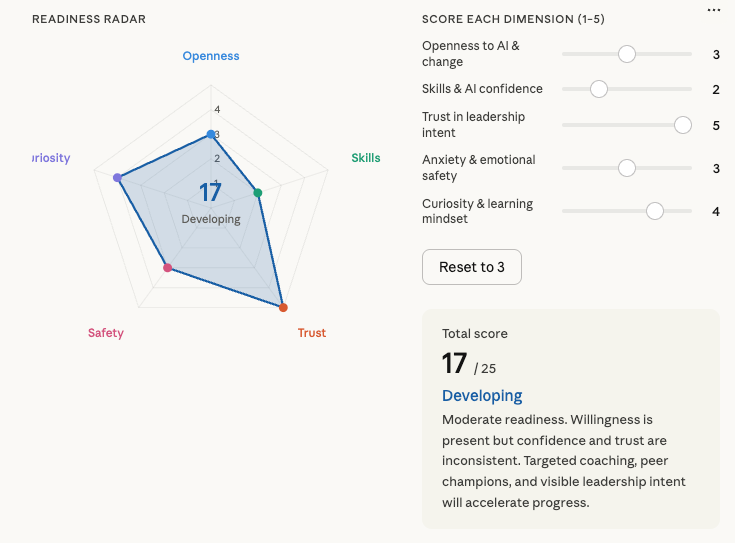
Start by entering your five scores from Part 1. As you move the sliders, your team's readiness pentagon forms instantly in real time. For consultants, input your observed client team scores, not survey averages, for sharper accuracy.
2. Detect your gap pattern
Instead of simply flagging your lowest dimension, the Navigator recognises one of six distinct patterns that drive or block AI adoption. Examples include:
High Curiosity + Low Skills — motivation without confidence
High Skills + Low Trust — capability with scepticism
Low Anxiety + Low Clarity — calm but directionless
Each pattern triggers a tailored intervention path, no fluffy tips, just targeted, behaviour-specific guidance.
But here is what makes this feature genuinely powerful: misreading the pattern does not just produce a neutral result. Treating a trust deficit with more training or a skills gap with a transparency session will not just fail to help. It will confirm the team's suspicion that leadership does not understand what is actually going on.
Getting the pattern right is not a refinement. It is the difference between momentum and backslide.
3. The decision tree
Leaders don't need complexity. They need clarity. The decision tree distils all your patterns into one focused question, one sharp choice, and one recommended next move. It's decision-making without the drain.
4. The intervention plan
Here's where your leadership roadmap appears. The tool weighs your team's profile and produces an immediate, prioritised list of interventions: the top three forming your focus for the next 30 days. Every action is mapped back to its readiness dimension, keeping intent visible.
5. The scenario simulator
Want to see what happens if your team improves just one dimension? Choose it. The Navigator projects the before-and-after readiness radar, side by side. You'll know exactly how much progress two points of improvement can create — or whether it elevates your entire team to a new tier.
For consultants, it's a live demo of ROI — tangible, not theoretical.
6. The leadership brief
Finally, the Navigator compiles your results into a personalised, four-page Leadership Intervention Brief complete with radar charts, gap patterns, the decision tree outcome, and your exact action plan. It downloads instantly as a PDF you can share in a meeting or client workshop.
Each line is generated from your data and decisions, from just insights that belong to you.
Who It's Designed For
Leaders and managers
Build immediate confidence and clarity in under ten minutes. Document your thinking and share it directly with HR or stakeholders without having to reconstruct the analysis from memory.
HR, L&D, and change practitioners
Run it across multiple teams to compare patterns, uncover distinct needs, and prioritise investments with evidence. The scenario simulator helps you make the case for where to invest first.
Consultants and coaches
Use it live in client sessions to co-create plans, visualise progress, and hand over the PDF brief as concrete value. The before-and-after radar is particularly effective for helping clients visualise the return on an intervention before they commit to it.
How to Get the Most From It
The Navigator works best when you bring a specific team to mind and score based on actual behaviours you have observed, not hopeful aspirations. That distinction alone will change what the tool surfaces.
Complete the AI Readiness Diagnostic (Part 1) — thegainlab.co/post/ai-readiness-diagnostic-tool
Note your five dimension scores
Open the Navigator (embedded below)
Follow each step in sequence, each builds on the one before
In Step 5, run at least two simulation scenarios before moving on
In Step 6, generate and download your leadership brief
After the Navigator: Building the Human Advantage
The Navigator shows you the path forward. But walking it, leading people through change, rebuilding trust, unlocking confidence in a team that has been hesitant, takes a different kind of skill.
The Navigator tells you where to start. What it cannot give you is the leadership muscle to follow through, to hold a room when anxiety is high, to rebuild trust after it has been eroded, to keep going when the team is not moving as fast as you hoped. That is a different kind of work. And that is what The Human Advantage is built for.
COMING Q2 2026 · EARLY BIRD NOW OPEN
The Human Advantage: AI + EI
The flagship programme from The Gain Lab
Where the Navigator tells you what to prioritise, The Human Advantage equips you to do it, combining Artificial Intelligence with Emotional Intelligence. Together, they form a complete system for human-centred AI adoption.
What you'll learn:
How to use the Diagnostic and Navigator to craft precise adoption strategies
The neuroscience of resistance — and how emotional intelligence breaks through it
How to use AI as an amplifier for empathy and connection
Leadership habits that build psychological safety and trust
Practical tools to turn AI sceptics into advocates
Experience a more advanced version of the AI Adoption Navigator: one that factors in organisation size, industry, and context for tailored recommendations unique to your team.
Join the early bird list now. Limited spots, exclusive pricing, no commitment.
We will only email you about The Human Advantage. Unsubscribe any time.
How do I turn an AI readiness score into an action plan?
To turn an AI readiness score into an action plan, move from measurement to interpretation. Identify which gap pattern your team's radar reflects, not just the lowest score, but the combination of dimensions that interact. Then identify the presenting symptom and map it to a first intervention. The AI Adoption Navigator does this automatically: it detects your gap pattern, routes you through a decision tree, and generates a ranked list of interventions weighted to your specific profile.
What is an AI adoption gap pattern?
An AI adoption gap pattern is a specific combination of high and low readiness scores that creates a predictable barrier to AI adoption. A team with high skills but low trust will resist using AI openly even if they are technically capable, the barrier is relational, not technical. Identifying the pattern matters because the intervention is different for each one. Treating a trust deficit with more training, or a skills gap with a transparency session, will not work and may actively damage trust further.
How do I know which AI intervention to prioritise first?
Prioritise the intervention that addresses the gap pattern with the highest urgency and the lowest barrier to action. Low trust and high anxiety patterns should be addressed before skills gaps because no amount of training will land if the team does not believe leadership's intent is genuine. The AI Adoption Navigator's decision tree maps the most visible symptom in your team to the highest-leverage first move, removing the guesswork.

![Generative AI for SMEs in 2026: Practical Strategies, ROI and Singapore Case Examples [Updated]](https://static.wixstatic.com/media/11062b_6cfe88bddafd4b25b6a1fdb650c812c1~mv2.jpg/v1/fill/w_980,h_653,al_c,q_85,usm_0.66_1.00_0.01,enc_avif,quality_auto/11062b_6cfe88bddafd4b25b6a1fdb650c812c1~mv2.jpg)
Comments